Crystallizing Public Opinion: The Original 1923 Text
Edward L. Bernays | United States paperback edition
A confession: this page is built from the book’s own playbook. The moves are labeled in red as we make them. Watch yourself get sold.
"The only difference between ‘propaganda’ and ‘education,’ really, is in the point of view."
— Edward L. Bernays, 1923
↑ Reframing — the book’s signature move
The sentence above moves a loaded word into neutral territory by changing the vantage point — and it lowered your guard about everything that follows. Bernays calls this the point of view, and it is the working method of the whole book.
↑ Authority transfer
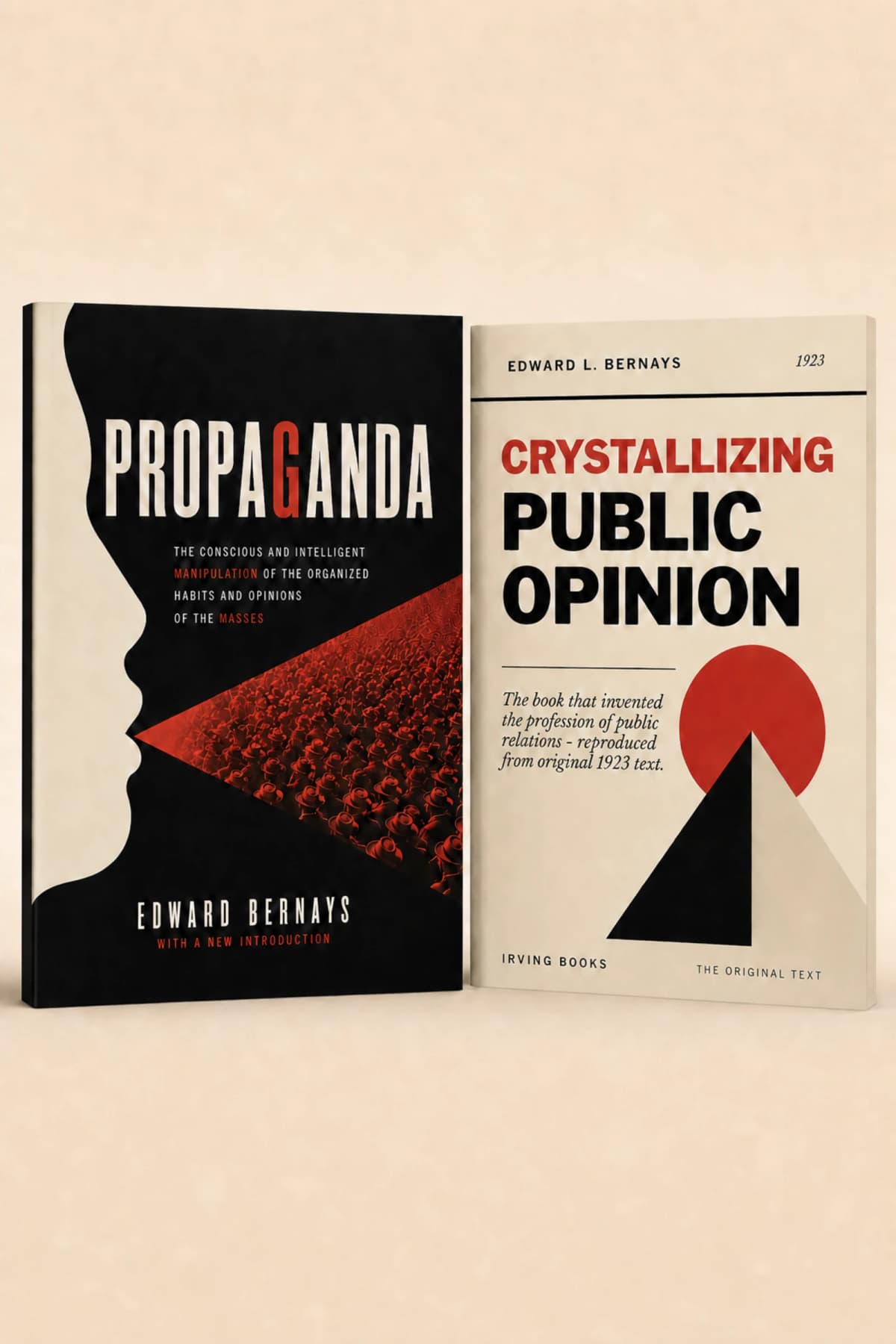
Five years before Propaganda, Edward L. Bernays — Sigmund Freud’s nephew — wrote the first book to define the profession he was creating. In Crystallizing Public Opinion (1923) he coined the term "public relations counsel" and set out, methodically, how public opinion forms and how it can be shaped. Founder of the field, Freud’s nephew: borrowed credibility, one sentence. That’s the technique, and you’ll recognize it everywhere once he shows you.
What’s in the book
Across four parts — Scope and Functions, The Group and Herd, Technique and Method, and Ethical Relations — Bernays draws on Lippmann, Trotter and the new psychology of the crowd to lay the groundwork for an industry that would remake the twentieth century. He defines the public relations counsel, shows how group and “herd” instinct govern opinion, sets out his technique and method, and closes on the ethics of the work.
↑ The herd point of view — Part II, in action
We could tell you this is one of the most consequential and least-read books of its period — and we just did. That’s social proof: Trotter’s herd instinct, the subject of Part II, working on you in a product description. When Napoleon said “Circumstance? I make circumstance,” Bernays wrote, he expressed very nearly the spirit of the public relations counsel’s work. This page is a small circumstance. The book is where you learn to see them being made.
About this edition
- The complete, unabridged original 1923 text (the 1934 “Preface to New Edition” is not included)
- The original 1923 author’s Foreword retained
- Checked against the public-domain transcription (Project Gutenberg ) and source scans
- Perfect-bound paperback, 6 × 9 in (229 × 152 mm)
- 166 pages, set in a readable serif suitable for annotation
- United States edition
↑ Genuine scarcity, not the manufactured kind
No countdown, no “price rises tonight.” The paperback is in stock and ready to order. (The price is $25.)
P.S. You read all the labels and you’re still considering it. That’s not a failure of resistance — it’s the whole argument for the book. Bernays showed that knowing the mechanism and feeling its pull are two different things. The cure is to read the source.
About the author
Edward L. Bernays (1891–1995) was an Austrian-American writer and public-relations pioneer whose career spanned more than seventy years. His other works include Crystallizing Public Opinion (1923), Propaganda (1928), Public Relations (1952) and his autobiography Biography of an Idea (1965).
Territory availability
This edition is available for purchase only by customers in the United States, United Kingdom, and selected EU countries. The original 1923 text is in the public domain in the United States; copyright status in other jurisdictions may differ.