Propaganda: The Original 1928 Text
Edward L. Bernays | United States hardback edition
A confession: this page is built from the book’s own playbook. The moves are labeled in red as we make them. Watch yourself get sold.
"The conscious and intelligent manipulation of the organized habits and opinions of the masses is an important element in democratic society."
— opening line, 1928
↑ Authority transfer
In 1928 Edward L. Bernays — Sigmund Freud’s nephew, and the man history calls the father of public relations — wrote what is widely regarded as the founding text of modern PR. We just borrowed his credibility in a single sentence; the line above is the technique.
What’s in the book
Across eleven short chapters, Bernays argues that mass democratic society makes the organised management of opinion not only inevitable but necessary. He sets out how newspapers, professional associations, civic bodies, businesses, schools and political leaders co-operate — sometimes by design, often by habit — to shape what publics believe and what they want. He names the techniques, identifies the actors, and is unembarrassed about both.
↑ Appeal to self-interest
Here is the honest reason to read it: the methods Bernays laid out are still recognizable today — in advertising, in PR, in political campaigns. When he marketed cigarettes to women as “Torches of Freedom,” a symbol of emancipation, he showed a sale could be made of an idea, not just a product. Read the original and you stop being the audience and start seeing the staging. That is a skill worth the cover price — which is precisely why we’re framing it as one.
↑ Manufacturing consent — you’re in it now
By labeling each move instead of hiding it, we’ve made you trust the next thing we say — which is itself a move, and the most Bernaysian one on this page. So here is the plain fact with nothing behind it: the 1928 text is newly in the U.S. public domain, and this is the complete, unabridged edition, checked line by line against the original scans and set clean to read. The only thing we’re engineering is your attention. What you conclude is yours.
About this edition
- The complete, unabridged original 1928 text
- Checked against multiple public-domain source scans and transcriptions
- Compact casebound collector’s hardback
- 6 × 9 in (229 × 152 mm), 128 pages
- United States edition
↑ Genuine scarcity, not the manufactured kind
No countdown, no “price rises tonight.” The hardback is in stock and ready to order.
P.S. You read all the labels and you’re still considering it. That’s not a failure of resistance — it’s the whole argument for the book. Bernays showed that knowing the mechanism and feeling its pull are two different things. The cure is to read the source.
About the author
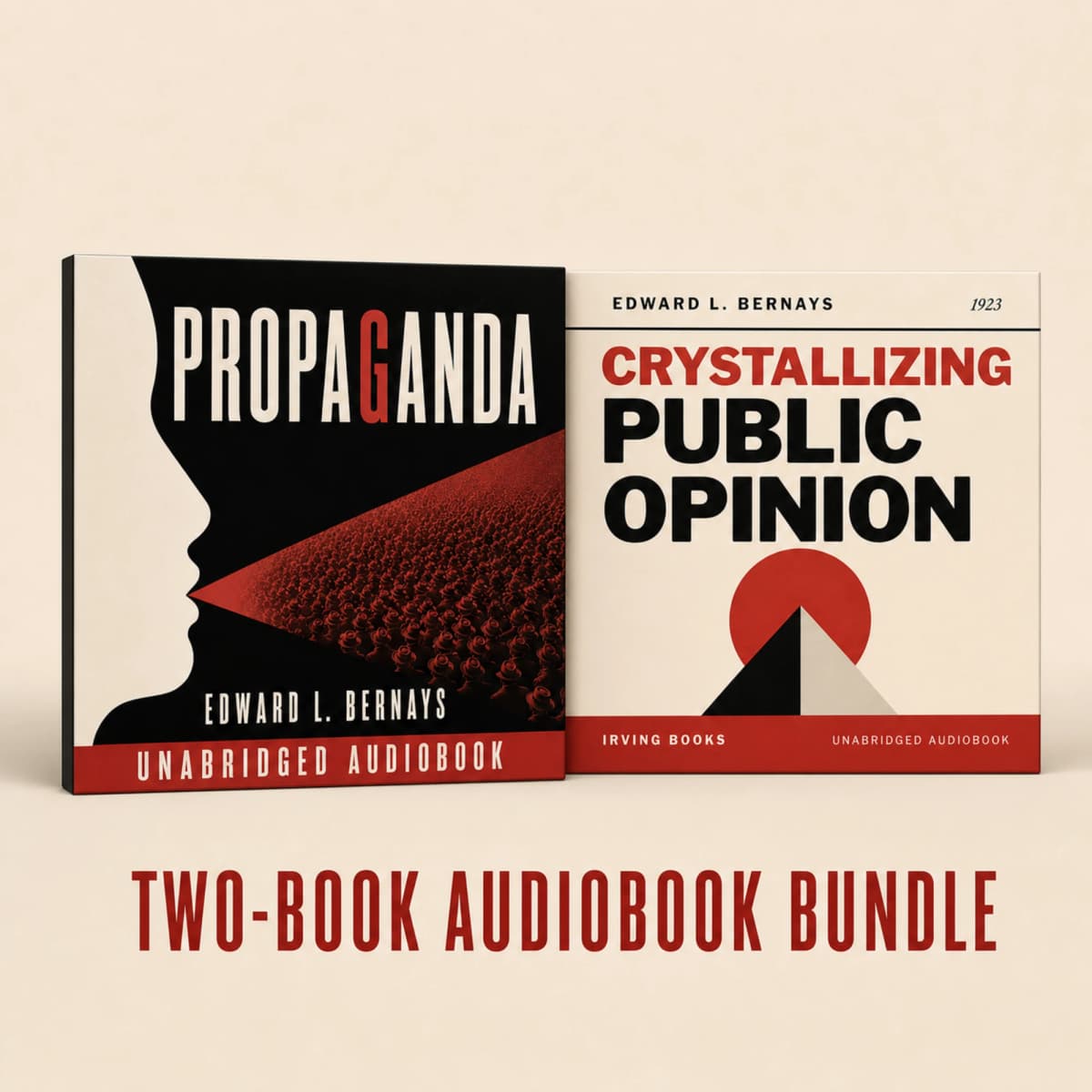
Edward L. Bernays (1891–1995) was an Austrian-American writer and public-relations pioneer whose career spanned more than seventy years. His other works include Crystallizing Public Opinion (1923), Propaganda (1928), Public Relations (1952) and his autobiography Biography of an Idea (1965).
Territory availability
This hardback edition is available for purchase only by customers in the United States, United Kingdom, and selected EU countries. The original 1928 text is in the public domain in the United States; copyright status in other jurisdictions may differ.