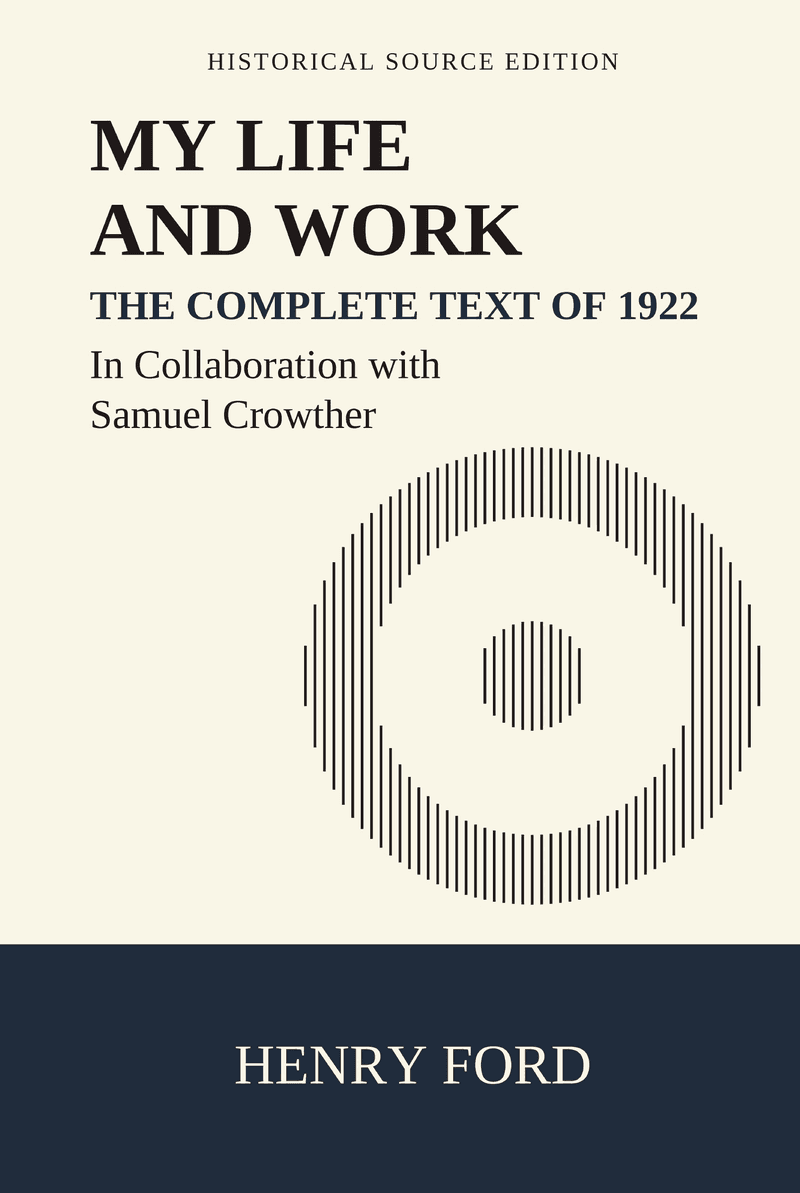
Henry Ford, one page a week
From 1919 Henry Ford kept one page of his own newspaper, The Dearborn Independent, for himself. He used it to say what he thought about wages, bosses, borrowed money, farms, cities, strikes, schools and war, in pieces short enough to read at a sitting. In February 1922 the paper gathered ninety-eight of them into one volume, chosen, its preface says, “upon the principle of popularity as expressed by our readers, and also upon the principle of diversity.” This is that book, complete.
“Success is the enemy. It is the only enemy that can overcome men who are invincible to failure.”
That is how the seventh column, “Be Very Careful of Success,” begins.
What Ford says
- On pay. One column is called “When in Doubt—Raise Wages!” Its advice is three words long: “Simply raise wages.”
- On debt. “The time for a business man to borrow money, if ever, is when he does not need it.”
- On the job. “The job is the barometer of the man.” And: “It is not work that men object to, but the element of drudgery in work.”
- On cities. The modern city is “probably the most unlovely sight this planet can offer.” The farm and the small town get the defence.
- On what war costs. One column sets the federal budget of $5,868,005,706 beside the $406,384,443 spent on “the real work of government,” and asks where the rest went.
- On change. “Society is always in danger from two classes, those who fear change, and those who crave it.”
Other columns ask whether married women should work, who the real owner of a business is, what makes immigration a “problem,” and why so much nonsense attaches to titles.
The page and the autobiography
Ford’s autobiography appeared in the same year, and the two books share more than a voice: some 250 sentences from 35 of these columns reappear word for word in My Life and Work. Read side by side, they show how closely the weekly page and the book are related.
Who wrote it
The page was prepared by the paper’s staff, chiefly William J. Cameron, from Ford’s ideas. The 1922 preface answers the question directly: “He supplies the ideas. Very often he supplies the words in which his ideas are set forth.”
Reader advisory
The columns were written between 1919 and early 1922, in the unsettled years after the First World War. Some express opinions on race, immigration, nationality, women and labour that readers today will find objectionable, and a few carry the themes of the antisemitic series the same newspaper was then running. That series itself is not part of this volume. Irving Books publishes the text complete for historical research and critical study, and does not endorse the views expressed.
This eBook
- Read it today. Download links are emailed immediately after checkout and remain available in your Irving Books account.
- Two files, no DRM. An EPUB with linked contents for e-readers, tablets and phones, and a PDF that matches the hardback page for page.
- The complete 1922 collection. All ninety-eight columns, with the paper’s original preface and a publication and reader’s note.
- Collated with the scans. Newly typeset from the 1922 printing and collated with three scans and the page images.
Prefer print? The hardback edition is open for pre-order.